


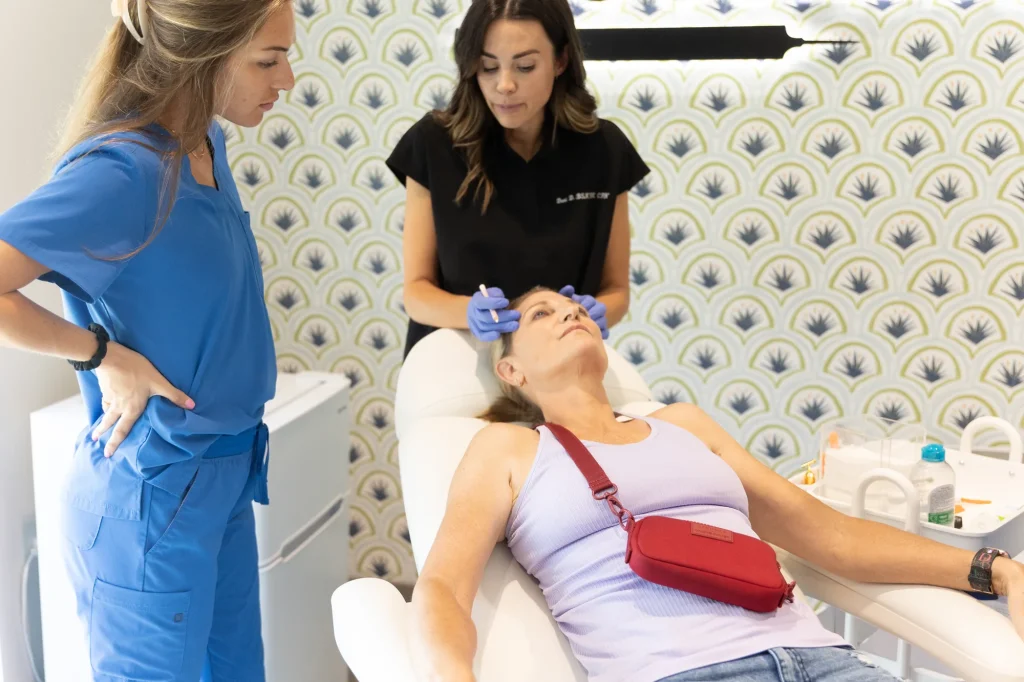
Two Botox courses can cover the same topics, last the same number of hours and cost about the same, yet give you very different experiences. One of the biggest differences is how many students share each instructor. In a group workshop, you take turns. In one-on-one training, every injection is yours.
This guide explains how each format works, what changes for you as a learner, when group training can be enough, and the questions to ask before you book.
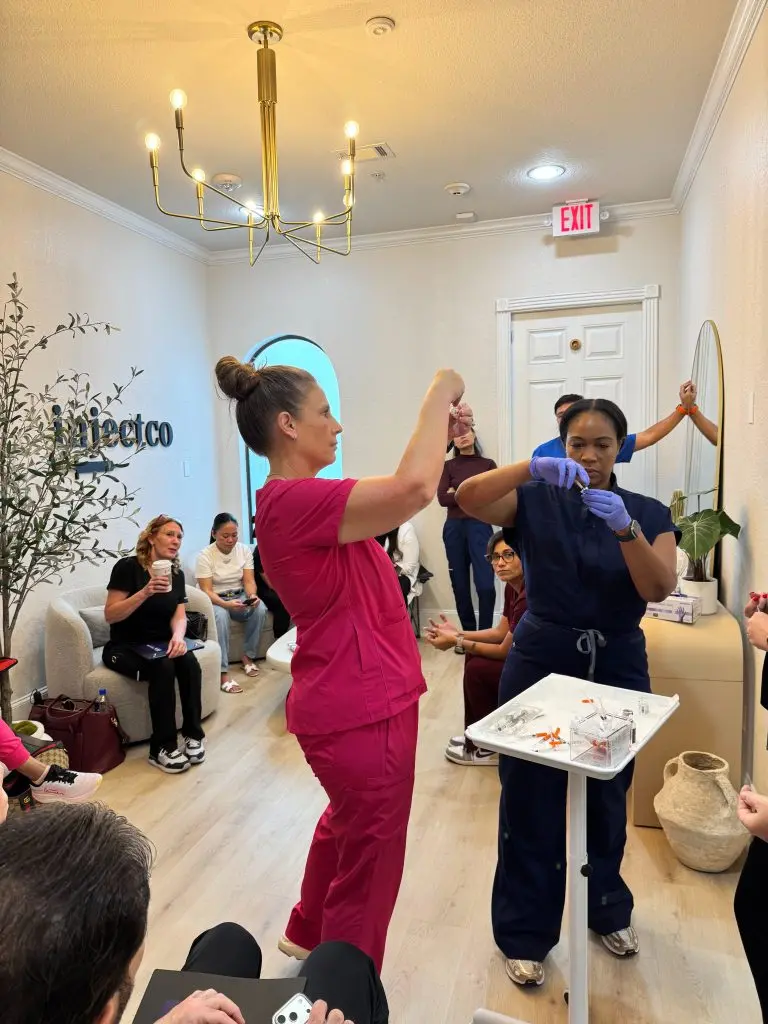
How Group Botox Workshops Typically Run
Group workshops are common, especially at national training companies that travel from city to city. A typical format looks like this:
- A morning lecture for the whole class on anatomy, products and safety
- A live demonstration by the instructor on one model
- Hands-on time, where students rotate through stations or share models
- Several students per instructor during the practical part of the day
Group training can be efficient and social. You hear other students’ questions and watch their technique. But your personal hands-on time depends on class size, the number of models and how the day is organized.

How One-on-One Training Works at ITA
At Injector Training Academy, both our programs are taught one-on-one. That means:
- One trainer, one student. Your instructor focuses entirely on you.
- Your own models. In the Injector Certification Program, you treat 3 neurotoxin and 3 filler models yourself. In the Aesthetic Injector Internship, you treat 6 neurotoxin and 6 filler models over 12 weeks.
- Products provided. Neurotoxin, filler and supplies are included.
- Your pace. If you need more time on anatomy or mapping, you take it.
Before your hands-on day, you complete a self-paced online course, so your in-person time is spent on assessment, planning and injecting rather than lectures. You can start with our online Botox training course.
What Changes for You
Time per injection
In a group, the instructor divides attention among several students. In one-on-one training, your trainer watches your hand position, depth, angle and dose on every injection and corrects you in real time. That feedback is how good habits form.
Questions
In a group, you may hold back a question because the class is moving on, or because it feels too basic. One-on-one, you can ask anything, as often as you need, including questions from the online course.
Pace
Group sessions move at the class’s pace. If you’re slower to map injection points or need to review facial muscles again, the schedule may not wait. One-on-one, the session adapts to you.
Treatment planning
One-on-one training gives you time to plan each model’s treatment yourself: assess, mark, choose dose or volume, explain to the patient and obtain informed consent. In some group settings, students inject a pre-planned area without doing the full assessment.
Safety and complications
Your trainer can walk through complication scenarios with you, from bruising to vascular compromise and the role of hyaluronidase for hyaluronic acid fillers, and connect them to the patient in front of you.
Confidence
New injectors often say the biggest change is confidence. Treating models yourself, start to finish, under close supervision, makes your first paid patient feel far less intimidating.
The Same Training Day, Two Ways
Imagine two nurses learning to treat frown lines on the same day.
In a group workshop, the first nurse joins five classmates. The instructor demonstrates on one volunteer, then students rotate through models. She injects two of the five points on one patient while others watch, then waits her turn for the next model. Her question about why the instructor changed the dose for a stronger muscle gets a quick answer, because the next student is ready.
In one-on-one training, the second nurse meets her model, takes the history, explains the treatment and gets consent. She asks the patient to frown, maps all five points herself and chooses the dose with her trainer’s guidance. The trainer corrects her needle angle on the second point and explains why the dose changes for a stronger muscle. Then she moves on to her next model and does it all again.
Both nurses finish with a certificate. Only one has planned and completed every step herself, several times.
Side-by-Side Comparison
| Group Workshop | One-on-One Training | |
| Students per instructor | Several | One |
| Hands-on injecting | Shared or rotated | All yours |
| Pace | Set by the class | Set by you |
| Questions | Limited by time | Unlimited |
| Treatment planning | Sometimes pre-planned | You plan each case |
| Social learning | High | Lower |
When Group Training Can Be Enough
Group training isn’t always the wrong choice. It can work if:
- You already inject and want an update on a specific technique
- You learn well by watching others and asking few questions
- Your employer will provide close, supervised practice after the course
- You mainly want didactic content, such as anatomy refreshers
If you’re new to injecting and will be practicing with limited supervision, one-on-one training usually gives you a stronger foundation.
Questions to Ask Before You Book
- How many students attend each session?
- How many students per instructor during hands-on time?
- How many live models will I personally inject, and for which treatments?
- Do I assess and plan each treatment myself?
- Are products and supplies included?
- What support is available after the course?
If a program can’t answer clearly, that tells you something too.
A Note on Practice After Training
Whatever format you choose, training prepares you to inject, but it doesn’t change your scope of practice. In Texas, registered nurses inject under physician delegation with a supervising physician and standing orders. Review licensing through the Texas Board of Nursing and delegation rules through the Texas Medical Board.
Train One-on-One in Texas
ITA offers one-on-one hands-on training across Texas, including Dallas, Fort Worth, Plano, Colleyville, Argyle, Waxahachie, Austin and The Woodlands. Compare both programs on our Botox and dermal filler training for registered nurses page. The same one-on-one approach applies to our advanced courses, including our penile injections training course.
Frequently Asked Questions
Is one-on-one Botox training better than group training?
For new injectors, one-on-one training usually means more personal injecting, more feedback and more time for questions. Group training can work for experienced injectors or those with strong supervision afterward.
Does one-on-one Botox training cost more?
Not always. Compare the cost per live model you personally inject. ITA’s one-on-one Injector Certification Program includes 6 live models and products for $3,000.
How many models will I treat in one-on-one training at ITA?
The Injector Certification Program includes 3 neurotoxin and 3 filler models. The Aesthetic Injector Internship includes 6 neurotoxin and 6 filler models.
Is private Botox training available for experienced injectors too?
Yes. One-on-one training also works well for experienced injectors who want to refine a technique or learn an advanced area, because the session focuses only on their goals.
Your Next Step
Before you book any course, ask how many people will share your instructor and your models. The answer often tells you more about the training than the price does.
Written by Kiara DeWitt, BSN, RN, CPN, Founder, President and Faculty Instructor at Injector Training Academy.
Disclaimer
Medical Disclaimer: The content on this page is for general educational and informational purposes only. It is intended for licensed healthcare professionals and is not medical, legal or financial advice. It is not a substitute for professional clinical judgment, and it is not meant for patients to use when making treatment decisions. Aesthetic procedures, including neurotoxin, dermal filler, PRP and PDO thread treatments, carry risks and must be performed only by appropriately licensed professionals within their scope of practice and under the medical supervision required in their state. Scope of practice, delegation and supervision rules vary by state and change over time, so confirm current requirements with your state licensing board, such as the Texas Board of Nursing or Texas Medical Board. Completing a training course or receiving a Certificate of Completion does not grant a license or expand your legal scope of practice, and it does not guarantee employment, income or specific clinical results. Links to outside websites are provided for reference only and do not imply endorsement. Information is accurate to the best of our knowledge at the time of publishing.