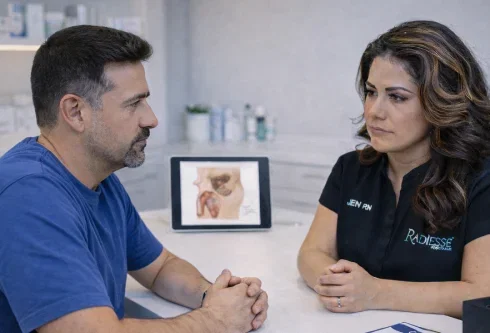
For experienced medical providers
Penile injection procedures require specialized knowledge of anatomy, patient assessment, treatment planning, and complication management. For healthcare professionals interested in expanding their clinical services, appropriate education and supervision are essential.
Injector Training Academy (ITA) offers information about specialized penile injection training for medical providers seeking to develop their knowledge of sexual wellness and aesthetic procedures.
Before enrolling, prospective students should confirm the program’s clinical prerequisites, eligibility requirements, training format, and available practical instruction.
Penile injection training is intended for medical providers with relevant clinical experience.
Because these procedures involve sensitive anatomy and potentially serious complications, providers should have an appropriate foundation in patient assessment, injection safety, contraindications, and complication recognition.
Specific prerequisites for ITA’s penile injection course must be confirmed with the admissions team before enrollment.
If you are a licensed healthcare professional without prior aesthetic injection experience, consider beginning with ITA’s Injector Certification Program. The $3,000 program combines approximately six hours of self-paced online education with a private, one-on-one hands-on clinical training day. Students practice on six live models, including three neurotoxin and three dermal filler models, under direct supervision.
Explore our Botox and filler training to learn more about foundational injectable education. Completion of the Injector Certification Program does not automatically establish eligibility for advanced penile injection training.
Eligibility for this specialty course depends on ITA’s confirmed admission requirements and the professional’s applicable license and scope of practice.
Healthcare professionals interested in enrolling should contact ITA to confirm whether their qualifications meet the course prerequisites.
Training eligibility does not independently authorize a provider to perform penile injections. Before offering these treatments, clinicians must verify applicable licensing, prescribing, delegation, supervision, and facility requirements in their state.
Penile injections may be used in the management of erectile dysfunction or for selected aesthetic and sexual wellness applications. Different procedures involve different medications, products, treatment goals, and clinical considerations.
Intracavernosal injection therapy involves administering prescribed medication into erectile tissue to support an erectile response.
Examples include alprostadil and certain compounded medication combinations.
Treatment requires appropriate medical evaluation, prescribing oversight, patient education, and monitoring for adverse effects.
Penile enhancement procedures may involve injectable fillers intended to alter penile girth or appearance.
These treatments require careful consideration of product selection, vascular anatomy, informed consent, and potential complications.
Not all injectable products are approved for penile enhancement, and clinicians must understand the regulatory status of the products they use.
Some injectable treatments, including botulinum toxin and platelet-based procedures, have been investigated for selected sexual health applications.
Evidence and regulatory status vary by treatment.
Emerging or investigational procedures should not be presented as established alternatives to approved therapies without appropriate supporting evidence.
A comprehensive patient assessment is an essential part of responsible penile injection care.
Clinicians should evaluate relevant medical history, treatment goals, contraindications, medication use, and potential risks.
Patients should receive clear information about expected outcomes, treatment limitations, alternative options, and possible complications. Informed consent should be documented before treatment.
Penile injection procedures carry risks that vary according to the treatment and product used.
Potential complications may include pain, bruising, bleeding, infection, tissue injury, fibrosis, and prolonged erections. Priapism is a potentially serious complication of certain erectile dysfunction injections and requires prompt medical evaluation.
Clinicians must understand appropriate patient selection, sterile technique, emergency response procedures, and follow-up care. Practical training should be undertaken only within an appropriate supervised clinical environment.
Healthcare professionals must follow the laws and regulations governing their clinical practice. Requirements may involve physician delegation, prescribing authority, supervision, facility policies, and professional licensing restrictions.
In Texas, cosmetic injection procedures are subject to applicable medical delegation and supervision requirements.
ITA can help interested professionals explore medical director placement resources through Medical Director Co. Any arrangement must be independently reviewed for compliance with applicable state laws and the specific procedures being offered.
Contact ITA to confirm whether the penile injection course issues a Certificate of Completion.
If provided, the certificate documents participation in the specified training. It does not expand the holder’s professional license or legal scope of practice.
ITA’s programs don’t currently award CE or CME credits.
Tell us a little about yourself and an ITA team member will follow up about eligibility, prerequisites and course availability.
Prefer to talk it through? Call (817) 768-9230.
This course is positioned for experienced medical providers. Specific experience requirements must be confirmed with ITA before enrollment. Licensed professionals new to aesthetic injectables may explore the foundational Injector Certification Program first.
Eligibility depends on the professional’s license, clinical background, and ITA’s confirmed specialty course requirements. Contact the admissions team to verify whether your qualifications meet the prerequisites.
Contact ITA to confirm the current course format, whether supervised practical instruction is included, and the procedures covered.
No training course independently grants clinical authority. Providers must meet applicable licensing, prescribing, delegation, and supervision requirements before performing these procedures.
Please confirm with ITA whether the course awards a Certificate of Completion. ITA’s programs do not currently award CE or CME credits.
Specialized penile injection procedures require appropriate clinical preparation, patient assessment, and a strong understanding of treatment safety.
Injector Training Academy can help you explore available education, clarify course prerequisites, and determine whether the training aligns with your professional background.
Contact ITA to discuss eligibility, course availability, and the next steps toward specialized clinical education.
Start or advance your career with hands on training, expert instructors, and nationally recognized certification paths.