

Microneedling Training in Texas
Microneedling training in Texas has become one of the most requested programs in medical aesthetics education. Skin rejuvenation is a high-demand service category, and microneedling sits at the center of it. Patients actively seek treatments that improve texture, reduce scarring, and deliver visible results with minimal downtime.
Safe microneedling requires proper hands-on training, not just classroom instruction. The technique involves real clinical judgment, device specific skill, and patient assessment competency that only develops through practice on real skin. ITA, through Injectortraining.org, delivers that experience in a supervised clinical setting backed by instructors who have trained 2,000 + students across Texas.
Whether you are exploring aesthetic training in Texas for the first time or expanding an existing practice, microneedling classes in Texas give you a repeatable service that patients come back for.
What Is Microneedling?
Microneedling, also called collagen induction therapy, uses fine needles to create controlled micro-injuries in the skin. Those injuries trigger the body’s natural wound healing response, which drives collagen and elastin production in the treated area.
How Microneedling Works
The device creates thousands of microchannels in the epidermis and upper dermis. The depth of those channels is set by the provider based on the treatment goal and patient skin type. Shallower depths target surface-level texture and product absorption. Deeper settings reach the dermis to address scarring and skin laxity.
The healing response begins within hours of treatment. New collagen forms over the following weeks, which is why results continue to improve long after the appointment.
Skin Healing Response
The inflammatory cascade triggered by microneedling is the mechanism behind its results. Controlled skin injury prompts fibroblast activity, which increases collagen type I and III production. That new collagen remodels the treated tissue, improving elasticity and surface quality over time.
Benefits of Treatment
Microneedling addresses a wide range of patient concerns across different skin types. Common treatment indications include:
- Acne scars and post-inflammatory scarring
- Fine lines and wrinkles, particularly around the eyes and mouth
- Uneven skin texture and enlarged pores
- Hyperpigmentation and uneven tone
- Stretch marks on the body
- General skin laxity and dullness
A single device and skill set covers multiple patient concerns.
Who Can Take Microneedling Training in Texas?
Microneedling training is open to licensed medical professionals who operate within a Texas scope of practice framework. ITA’s program serves a broad range of provider types.
Eligibility depends on your professional license and the rules where you practice. Check your state’s rules before enrolling.
Registered Nurses (RNs)
RNs can perform microneedling in Texas under physician delegation. A valid delegation agreement must be in place, and the physician must be available for supervision as required under Texas Medical Board rules. RNs who complete microneedling training are well-positioned to offer this service in med spa and clinical settings.
Nurse Practitioners (NPs)
NPs with prescriptive authority agreements can incorporate microneedling into their practice. Their collaborative agreement should reflect the expanded service offering. Microneedling training for nurse practitioners provides both the clinical technique and the documentation foundation needed to operate compliantly.
Physician Assistants (PAs)
PAs may perform microneedling under a supervision agreement with their collaborating physician. The agreement should explicitly address aesthetic procedures. PAs who complete hands-on microneedling training bring an immediately deployable skill to any aesthetics practice.
Physicians
Physicians may perform microneedling independently and may delegate the procedure to qualified staff under Texas Medical Board standards. Physician-level training focuses on advanced techniques and supervision protocol design.
Medical Aestheticians
Medical aestheticians in Texas operate under a more limited scope than licensed medical professionals. The ability to perform medical-grade microneedling depends on the setting, the device classification, and the supervising physician structure. Candidates from this background should confirm their scope with a Texas healthcare attorney before enrolling.
Med Spa Professionals
Med spa owners and managers who hold appropriate clinical licenses benefit from microneedling training as a clinical skill. Understanding the procedure at a clinical level supports better staff training, quality control, and patient consultation.
Texas Scope Discussion
Medical-grade microneedling in Texas is classified as a medical procedure. The Texas Medical Board governs delegation to non-physician providers. A supervising physician must be involved in the practice structure, and pre-treatment evaluation requirements apply. Estheticians working under a medical director model may be able to perform certain microneedling services depending on the specific device and practice setup.
What You Will Learn in Our Microneedling Course
The curriculum covers clinical technique, patient assessment, safety protocols, and combination therapy applications. Graduates leave with both the skill and the judgment to perform microneedling confidently in a professional setting.
Skin Anatomy
Effective microneedling starts with a working knowledge of skin structure. The course covers the layers of the epidermis and dermis, the role of fibroblasts and the extracellular matrix, and how needle depth interacts with different tissue layers.
Fitzpatrick Skin Typing
Skin type assessment is a prerequisite for safe treatment. The course trains providers to accurately classify patients across the Fitzpatrick scale and to adjust treatment parameters accordingly. Darker skin types require specific depth and device settings to avoid adverse pigment responses.
Microneedling Depth Selection
Depth selection is one of the most consequential clinical decisions in a microneedling treatment. The course provides clear protocols for matching depth to indication, from 0.25mm for superficial texture work to 1.5mm and above for scar revision. Providers learn to evaluate each patient individually rather than applying a fixed default.
Needle Cartridge Selection
Different cartridge configurations produce different outcomes. The course covers pin count, cartridge geometry, and when to select specific configurations based on treatment area and patient goals.
Patient Consultation
Consultation skills are trained alongside clinical technique. Providers learn to conduct thorough intake assessments, set realistic outcome expectations, and document clinical decisions.
Contraindications
Absolute and relative contraindications are covered in detail. These include active acne lesions in the treatment area, blood-thinning medications, autoimmune skin conditions, recent isotretinoin use, and pregnancy.
Treatment Protocols
Complete session protocols from room setup through post-treatment care are part of the curriculum. Providers graduate with a repeatable system they can implement immediately.
Combination Therapies
The course introduces combination approaches that can improve clinical outcomes. These include:
- PRP microneedling: Platelet-rich plasma applied during or after treatment to support healing and boost results
- RF microneedling: Radiofrequency energy delivered through insulated needles to add skin tightening to the collagen-building response
- Serum infusion techniques: Active ingredient delivery through open microchannels to amplify treatment effects
Hands-On Microneedling Training
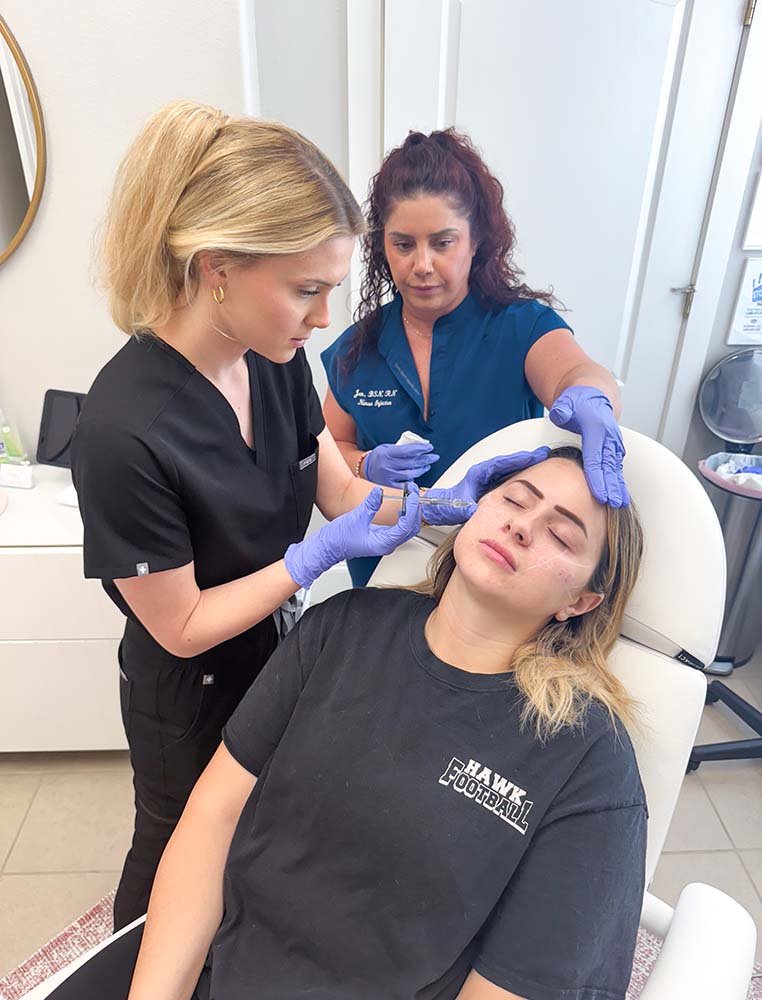
The clinical component of ITA’s microneedling program is where theoretical knowledge becomes real skill. Providers practice on live models in a supervised training environment. That direct patient experience is what separates graduates who are clinic-ready from those who still need time to develop confidence.
Live Model Practice
Every enrolled student performs treatments on real training models. This is not a simulation. Providers work through full patient encounters from consultation to post-treatment instruction under instructor supervision.
Device Handling
Hands-on device training covers proper technique, device movement patterns, and pressure calibration. Each device has specific handling characteristics that only become intuitive through practice.
Treatment Mapping
Providers learn to approach the face and body as treatment maps rather than areas to cover uniformly. Different zones require different depths, speeds, and passes. Treatment mapping skills build more predictable outcomes.
Sterile Techniques
Infection prevention is a core curriculum element. Sterile field setup, cartridge handling, and post-treatment wound care are trained to professional clinic standards.
Real Patient Consultations
Providers conduct live consultations with training models before treatment begins. This builds the communication skills needed to manage patient expectations and document consent accurately.
ITA maintains small class sizes to ensure every student gets meaningful hands-on time. Instructors have performed thousands of treatments within the ITA network. A Certificate of Completion is included upon program completion.
ITA doesn’t currently award CE or CME credits.
RF Microneedling vs Traditional Microneedling
RF microneedling combines standard collagen induction with radiofrequency energy delivered directly into the dermis. The two modalities address overlapping concerns but work through different mechanisms.
How RF Energy Works
Traditional microneedling relies on mechanical injury to trigger the healing cascade. RF microneedling adds thermal energy through insulated needles, heating the deeper dermis to drive additional collagen contraction and remodeling. The thermal component targets tissue at a level mechanical needles alone cannot reach as consistently.
Skin Tightening Benefits
The primary advantage of RF microneedling over standard microneedling is skin tightening. The thermal coagulation zones created by RF energy produce more pronounced laxity improvement, particularly in the lower face, jawline, and neck. Radiofrequency energy stimulates dermal collagen contraction at a tissue depth that produces measurable lifting results.
Downtime Comparison
Traditional microneedling typically involves 24 to 48 hours of redness and mild sensitivity. RF microneedling downtime is similar at lower settings but can extend to 3 to 5 days at more aggressive parameters. The trade-off is greater outcome intensity with slightly longer recovery.
Treatment Indications
Traditional microneedling is the stronger choice for superficial texture work, acne scarring, and hyperpigmentation. RF microneedling is indicated when skin laxity is the primary concern, or when a patient wants combined tightening and resurfacing in a single session.
Benefits of Adding Microneedling to Your Practice
Combination treatment packages
Microneedling integrates naturally with other services already offered in most med spas. Botox, dermal fillers, chemical peels, and laser treatments all pair well with microneedling in sequenced treatment plans.
Minimal downtime procedures
Patients who avoid more aggressive resurfacing procedures because of downtime concerns are strong candidates for microneedling. The brief recovery period makes it accessible to working professionals who cannot take extended time off for healing.
Multiple-session treatment series
Microneedling requires multiple sessions for optimal results, typically three to six treatments spaced four weeks apart.
Microneedling Safety & Complications
Safe outcomes in microneedling depend on thorough assessment, proper technique, and clear patient communication about aftercare.
Infection Prevention
Sterile single use cartridges must be used for every patient. Reusing cartridges is a serious safety violation that carries infection risk and cross-contamination liability. Proper skin preparation before treatment and barrier protection during the procedure are standard safety requirements.
Needle Safety
Sharps disposal must follow clinical standards. Used cartridges are medical waste and must be handled accordingly.
Hyperpigmentation Risks
Post-inflammatory hyperpigmentation is the most common adverse outcome from microneedling. Risk factors include darker skin types, treatment in recently sun-exposed skin, and inadequate depth calibration for the patient’s Fitzpatrick type. SPF compliance before and after treatment significantly reduces PIH incidence.
Proper Aftercare
Patients receive written aftercare instructions at every session. Key guidance includes avoiding active ingredients such as retinoids and acids for 48 to 72 hours post-treatment, keeping the skin clean and hydrated, and wearing SPF daily during the healing period.
Contraindications
Providers must screen for active skin infections, open lesions, blood-thinning medications, autoimmune skin conditions, and recent isotretinoin use before proceeding with treatment. These must be reviewed at every appointment, not just at the initial consultation.
Get Certified with Injector Training Academy
Why Choose Injectortraining.org?
ITA’s training programs through InjectorTraining.org are built around one principle: real-patient practice under experienced supervision.
Trust factors that distinguish the program include:
- Hands-on clinical training with live models at every program
- Instructors who have collectively performed more than 15,000 treatments
- Texas-based training across 9 locations in the state
- Medical aesthetics expertise grounded in the InjectCo clinical network
- Live demonstrations before every hands-on session
- Ongoing support for graduates building their practices
- Travel voucher program for out-of-state students
The instructors who teach at ITA are working professionals. They bring current clinical experience into every training session, not just curriculum content.
Ready for injectables?
If you are a licensed clinician who wants to add neurotoxin and filler to your services, the Injector Certification Program combines an online course with a private, one-on-one hands-on training day. You inject six live models, three neurotoxin and three dermal filler, and the program costs $3,000. Explore Botox and filler training for the full details.
Find ITA training near you
ITA provides hands-on training across nine Texas locations. Select your city to see its page, and ask the ITA team which locations host the microneedling course.
See this location’s page.
See this location’s page.
See this location’s page.
See this location’s page.
See this location’s page.
See this location’s page.
See this location’s page.
See this location’s page.
See this location’s page.
Frequently Asked Questions
Course length varies by program format. The length depends on the depth of the curriculum and on whether combination therapies such as RF or PRP are included. Call ITA at (817) 768-9230 for the current schedule and format.
RNs must operate under physician delegation to perform medical-grade microneedling in Texas. Documented training and demonstrated competency are required components of the delegation framework. Formal training supports that documentation.
Advanced topics including RF microneedling are covered in the curriculum. Contact the admissions team to confirm current course inclusions and available upgrade options.
Medical-grade microneedling is a medical procedure in Texas. Estheticians operating under a physician-supervised med spa model may be able to perform certain services depending on device classification and practice structure. Confirm specific scope with a Texas healthcare attorney before proceeding.
Training is conducted on professional-grade medical microneedling devices used in clinical settings. Device-specific information is available through the InjectorTraining.org course inquiry form.
No. ITA doesn’t currently award CE or CME credits. A Certificate of Completion is included upon program completion.
Enroll in Microneedling Training in Texas
ITA’s microneedling program gives licensed medical professionals the hands-on training and clinical judgment to add this service with confidence.
To ask about class dates, visit InjectorTraining.org or call the ITA admissions team at (817) 768-9230.