New aesthetic injectors face a critical decision when starting their training journey: should you learn Botox or fillers first? This question creates significant confusion among nurses, nurse practitioners, and other healthcare professionals entering aesthetic medicine. Both neurotoxins and dermal fillers are essential injectable skills, but choosing the right starting point dramatically impacts your learning curve, confidence development, and early career success.
Understanding the differences between Botox vs fillers training helps you make informed decisions about your educational pathway. Botox and dermal fillers serve completely different purposes, require distinct skill sets, and present unique challenges for new injectors. Most experienced practitioners strongly recommend a specific learning sequence that builds competence systematically rather than attempting everything simultaneously. This comprehensive guide explains exactly which injectable training you should pursue first and why that sequence matters.
Understanding Botox Training
Botox training focuses on neurotoxin injections that temporarily relax muscles causing dynamic wrinkles. Understanding what Botox does and how practitioners use it clarifies why most experts recommend starting your injectable education here.
What Botox Is and How It Works
Botox is a brand name for botulinum toxin type A, a neuromodulator that temporarily blocks nerve signals to muscles. When injected into specific facial muscles, Botox prevents those muscles from contracting fully. This muscle relaxation smooths wrinkles caused by repetitive facial expressions like frowning, squinting, and raising eyebrows.
The mechanism is purely functional, not structural. Botox doesn’t add volume or physically fill wrinkles. It works at the neuromuscular junction, interrupting the chemical signals that cause muscle contraction. Results appear gradually over 3-14 days as the neurotoxin takes effect and treated muscles relax.
Effects last approximately 3-4 months before the body metabolises the product and muscle function gradually returns. This temporary nature creates regular repeat business, with most patients returning 3-4 times annually for maintenance treatments.
Botox, Dysport, Xeomin, and Jeuveau are the primary neurotoxin brands available. They all work through the same mechanism with slight variations in formulation, diffusion patterns, and onset timing. Most training programmes teach principles applicable to all neurotoxin products.
Common Botox Treatment Areas
Neurotoxin treatments target specific muscle groups creating dynamic wrinkles. The most common treatment areas represent the foundation every new injector masters.
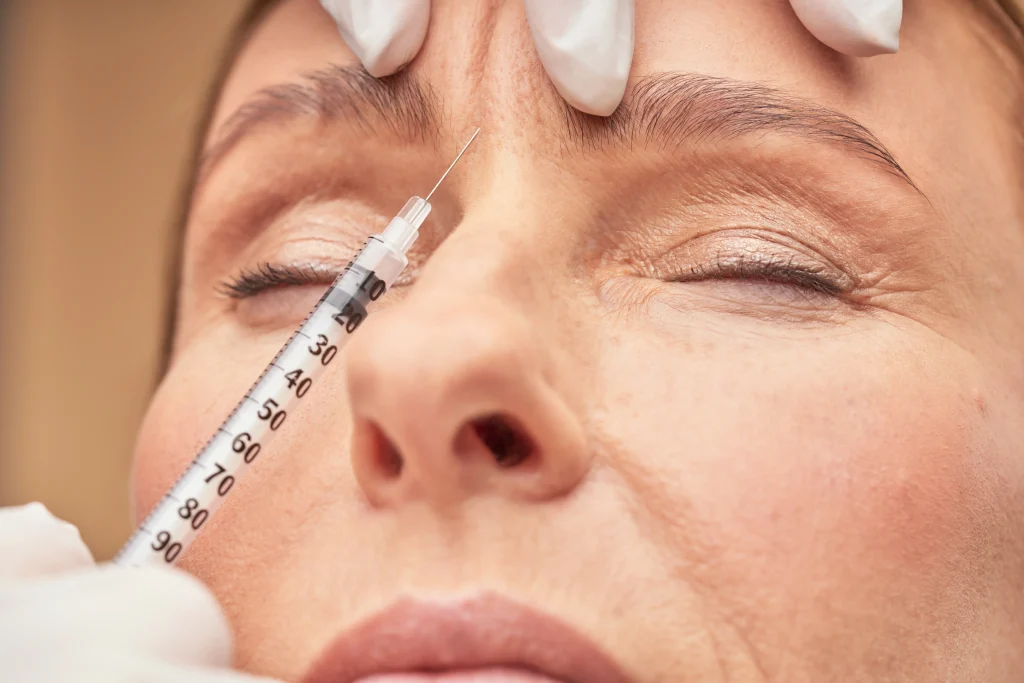
Glabella lines, the vertical furrows between eyebrows, are often the very first area new injectors learn. This treatment zone has clear anatomical landmarks, predictable muscle patterns, and forgiving margins for error. Most training programmes start every student here.
Forehead lines, the horizontal wrinkles across the forehead, are typically the second area taught. Treatment requires understanding how much relaxation creates smooth appearance without causing brow ptosis or frozen expression. This area teaches dosing judgment.
Crow’s feet, the wrinkles radiating from the outer corners of eyes, complete the “basic three” zones most new injectors master initially. These periorbital lines respond beautifully to neurotoxin treatment with high patient satisfaction.
Advanced Botox areas include masseter muscles for jaw slimming, platysmal bands in the neck, gummy smile correction, lip flip, and brow lift techniques. New injectors should master basic zones thoroughly before attempting these sophisticated applications.
Why Botox Is Considered Beginner-Friendly
Experienced injectors and educators consistently recommend Botox training before filler training for several compelling reasons.
Injection patterns are standardised and predictable. Glabella treatment uses 5 injection points in consistent locations. Forehead patterns are grid-based. Crow’s feet follow established placement protocols. This standardisation reduces variables while you’re developing basic injection skills.
Dosing is straightforward with clear guidelines. Most areas have recommended starting doses measured in units. While customisation develops with experience, new injectors can follow established protocols safely and effectively initially.
Immediate correction of minor errors is possible with neurotoxins. If you slightly misplace an injection, the diffusion properties of Botox often compensate. Effects are never permanent, resolving completely within 3-4 months even if results aren’t perfect.
Complication risks are relatively low when proper technique and dosing are followed. The most common “complications” are minor asymmetry, temporary eyelid droop, or insufficient effect. These resolve on their own without intervention as the product wears off. The FDA monitors safety information for all botulinum toxin products to support safe clinical use.
Visual results develop gradually, giving patients time to adjust to their new appearance. Unlike fillers where changes are immediate and obvious, Botox creates subtle improvements over days. This gradual change feels less dramatic to patients.
Understanding Dermal Fillers Training
Dermal filler training involves learning to restore volume, enhance contours, and create structural support using injectable gel products. This training is significantly more complex than neurotoxin education.
What Fillers Are and Their Composition
Most modern dermal fillers are hyaluronic acid-based products. Hyaluronic acid is a naturally occurring substance in human skin that holds water and creates volume. Injectable fillers use cross-linked hyaluronic acid gel that maintains shape and structure after injection.
Different filler products have varying characteristics including particle size, cross-linking density, and cohesivity. These properties determine which filler suits which application. Some fillers work best for fine lines, others for cheek volume, and still others for jawline contouring.
Fillers work by physically occupying space under the skin, creating volume where it’s injected. Unlike Botox’s functional approach, fillers produce immediate structural changes visible instantly after treatment.
Results last 6-18 months depending on product type, injection location, and patient metabolism. Some areas maintain filler longer than others. Lips metabolise product faster than cheeks, for example.
Other filler types include calcium hydroxylapatite (Radiesse) and poly-L-lactic acid (Sculptra). These biocompatible materials stimulate collagen production alongside providing immediate volume. They require different injection techniques than hyaluronic acid fillers.
Common Dermal Filler Applications
Filler treatments address volume loss, enhance features, and restore youthful contours throughout the face. The variety of applications exceeds neurotoxin uses significantly.
Lip augmentation is one of the most requested filler treatments. Patients seek fuller lips, better definition, or correction of asymmetry. This application requires artistic skill, understanding of lip anatomy, and knowledge of how much product creates natural versus overdone results.
Nasolabial folds, the lines running from nose to mouth corners, are classic filler indications. Treatment requires understanding how volume placement affects surrounding areas and avoiding overfilling that creates unnatural appearance.
Cheek augmentation restores volume lost with aging or enhances naturally flat cheeks. Proper placement creates lift throughout the midface. Poor placement creates lumpy, unnatural appearance.
Tear trough treatment addresses hollowing under eyes creating tired appearance. This is one of the most technically challenging filler applications due to thin skin, visible vascular structures, and high complication risk with improper technique.
Jawline contouring and chin augmentation use filler to create definition and balance. These treatments require substantial product volumes and advanced understanding of facial aesthetics and proportions.
Advanced Artistry and Technical Demands
Filler injection is often described as equal parts science and art. Technical precision combines with aesthetic judgment to create beautiful, natural results.
You must develop three-dimensional understanding of facial anatomy. Filler placement affects not just the injection site but surrounding areas through support and lift. Understanding these spatial relationships is essential to good outcomes.
You need refined aesthetic sense to evaluate facial proportions, balance, and harmony. Not every filler request should be fulfilled as asked. Sometimes what patients request would actually worsen their appearance. Skilled injectors guide patients toward treatments enhancing their natural beauty.
Product selection requires knowing which filler properties suit which applications. Using the wrong filler in a given location produces suboptimal results or complications. This knowledge develops through experience and training.
Injection techniques vary by location and desired effect. Superficial placement for fine lines differs from deep injection for structural support. Bolus techniques differ from threading or fanning. Mastering this variety takes substantial practice.
Key Differences Between Botox and Fillers
Understanding how Botox vs fillers training differs helps you appreciate why learning sequence matters.
Mechanism of Action Differences
Botox and fillers achieve aesthetic improvements through completely different mechanisms. Botox works functionally by relaxing muscles. Fillers work structurally by adding volume. This fundamental difference affects everything about how you learn, apply, and troubleshoot these treatments.
Neurotoxin effects are indirect. You inject Botox into muscles, it blocks nerve signals, muscles relax, and wrinkles smooth as a consequence. The relationship between injection and result involves biological processes occurring over days.
Filler effects are direct and immediate. You inject product into tissue, and that tissue immediately expands with the volume you’ve added. You see results instantly, including any mistakes.
This difference in timing affects how you learn. Botox allows you to inject, wait, and assess results days later. Fillers demand real-time judgment as you inject, continuously evaluating appearance and adjusting placement.
Complexity Level Comparison
Most experienced educators agree that Botox vs fillers training differs significantly in complexity, with fillers being substantially more challenging to master.
Botox has relatively few variables to manage. You’re choosing units to inject and specific muscle locations. While technique matters, the standardised patterns create clear frameworks for beginners.
Fillers involve numerous simultaneous variables. Product choice, injection depth, volume, technique, and placement all interact to create final results. Small changes in any variable significantly affect outcomes.
Botox complications are mostly minor and self-resolving. Slight asymmetry or temporary drooping corrects itself as product wears off. This forgiveness allows learning without catastrophic consequences.
Filler complications can be serious and require immediate intervention. Vascular occlusion from filler blocking blood vessels can cause tissue death or blindness. While rare with proper technique, these severe complications demand respect and extensive training.
Risk Factors and Complication Profiles
Patient safety concerns differ dramatically between neurotoxins and fillers. Understanding these risks helps you appreciate why filler training requires more extensive preparation.
Botox’s primary risks are aesthetic rather than medical. Asymmetry, overtreatment creating frozen appearance, or undertreatment with insufficient effect are the typical concerns. True medical emergencies are extremely rare.
Filler carries genuine medical risks including vascular occlusion, tissue necrosis, infection, and blindness. Injecting filler into or compressing blood vessels can stop blood flow to tissue, causing death of skin or even vision loss. Proper training in anatomy and emergency management is absolutely essential.
Bruising and swelling occur with both injectables but tend to be more pronounced with fillers. The gel volume and tissue disruption create more visible immediate aftermath requiring patient preparation and expectation management.
Allergic reactions to hyaluronic acid fillers are rare but possible. Delayed inflammatory reactions occasionally occur months after injection. Severe reactions such as anaphylaxis require different management than neurotoxin reactions.
Time Required to Master Each Skill
Developing genuine competence in Botox vs fillers training takes different timelines, with fillers requiring substantially more practice to reach proficiency.
Most new injectors feel comfortable with basic Botox treatments after 50-100 faces. The standardised patterns and clear dosing guidelines allow confidence building relatively quickly. Advanced techniques take longer, but foundation skills develop within months.
Filler competence takes significantly longer, typically 200-500 faces before new injectors feel truly proficient. The artistic judgment and spatial awareness required simply take more repetitions to develop. Many injectors report feeling fully confident with fillers only after 1-2 years of regular practice.
This timeline difference affects career planning. Nurses wanting quick entry to aesthetic practice benefit from starting with Botox, building confidence and income while continuing education toward filler competence.
Which Injectable Is Easier for Beginners?
When comparing Botox vs fillers training for new injectors, the answer is clear: Botox is significantly easier to learn first.
Botox Offers Simpler Injection Patterns
The standardised protocols for neurotoxin injection create structure helping beginners succeed. You’re following established patterns developed through decades of clinical use and research.
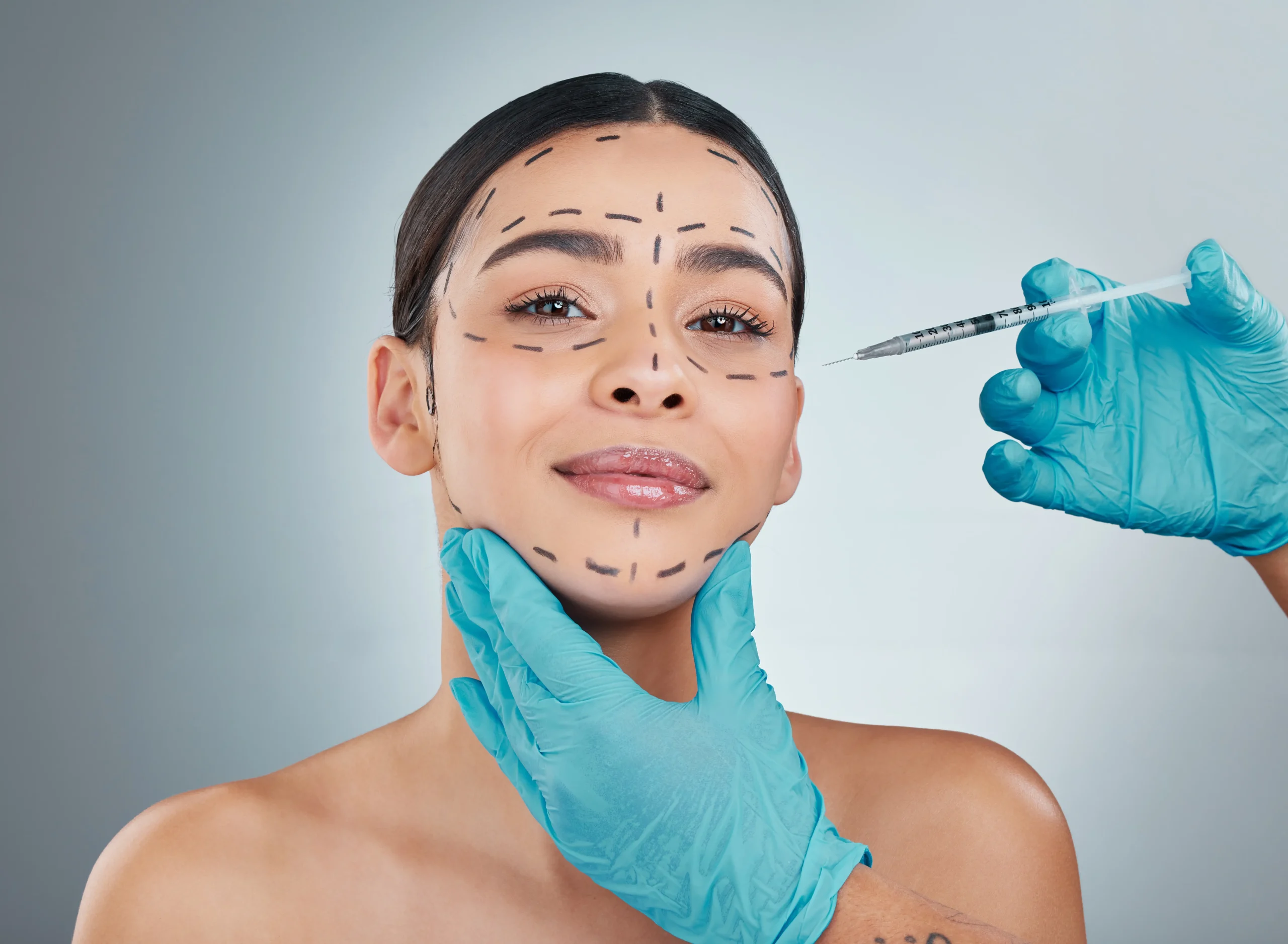
Glabella treatment uses five injections in consistent locations relative to anatomical landmarks. You can literally draw the pattern on patients’ faces before injecting, visualising exactly where needles will go.
Forehead patterns are grid-based with injection points spaced evenly. While you’ll customise spacing based on individual muscle patterns eventually, beginners follow standard grids safely.
These predictable patterns mean you’re not making complex spatial decisions while also learning basic needle handling, product reconstitution, and patient management. Simplicity in one area while learning another prevents overwhelm.
Fillers Require Deeper Anatomical Understanding
Successfully injecting fillers demands three-dimensional facial anatomy knowledge exceeding what Botox requires. You must understand tissue layers, fat compartments, vascular pathways, and ligamentous structures.
Knowing exactly which tissue plane to inject filler is critical. Superficial placement of product meant for deep injection creates lumps. Deep placement of superficial filler creates minimal visible effect. This precision requires anatomical knowledge Botox doesn’t demand.
Understanding vascular danger zones prevents catastrophic complications. You must know where facial arteries travel and recognise when needles contact vessels during injection. This knowledge protects patients from vascular occlusion.
Spatial awareness of how filler placement in one area affects surrounding regions requires sophisticated understanding. Cheek filler provides lift to nasolabial folds. Tear trough filler can create or worsen under-eye bags if placed incorrectly. These relationships aren’t intuitive.
Confidence Building With Neurotoxin Training
Starting with Botox allows you to develop fundamental injector skills in lower-risk environment before progressing to more complex procedures.
You’ll perfect needle handling, patient positioning, and basic injection technique with standardised, forgiving treatments. These motor skills transfer directly to filler injection later.
You’ll learn patient consultation, expectation management, and result assessment through Botox practice. These soft skills apply equally to filler treatments but develop more comfortably in lower-stakes neurotoxin context.
You’ll build professional identity as an injector and overcome initial nervousness about injecting faces. The psychological barriers to aesthetic injection are substantial for many new practitioners. Overcoming them with simpler procedures before advancing to complex ones makes sense.
You’ll establish patient base and income stream through Botox, creating financial stability while continuing education. This removes pressure to rush into filler training before you’re ready.
Income Potential: Botox vs Fillers
Understanding the financial aspects of Botox vs fillers training helps you plan career development and set realistic income expectations.
Treatment Pricing Comparisons
Botox and filler treatments have different pricing structures affecting your income potential with each skill.
Botox is typically priced per unit or per area. Unit pricing ranges $10-20 per unit in most markets. Area pricing bundles treatment zones for flat fees, such as $300-500 for full face neurotoxin treatment. Average treatment uses 30-60 units, generating $400-800 revenue per patient.
Dermal fillers are priced per syringe, typically $600-1,200 depending on product and market. Premium fillers and challenging areas command higher pricing. Many treatments use multiple syringes, creating $1,200-3,000+ revenue per patient easily.
Single treatment revenue is higher with fillers than Botox. However, this doesn’t automatically mean higher income. Frequency of treatments and patient volume matter equally.
Client Retention and Repeat Frequency
Both injectables create recurring revenue, but timing differs significantly between Botox vs fillers.
Botox patients return every 3-4 months for maintenance. This frequent return creates steady, predictable income. A patient receiving quarterly Botox generates $1,600-3,200 annual revenue.
Filler patients return every 6-18 months depending on product and location. Less frequent visits mean you need larger patient volumes to generate equivalent annual income. A lip filler patient returning annually generates $700-1,000 yearly revenue.
However, filler treatments often involve multiple syringes per visit. A patient receiving cheek and jawline filler might spend $2,400 in one appointment, more than they’d spend on entire year of Botox.
The ideal aesthetic practice offers both services, creating frequent Botox touchpoints and periodic larger filler treatments. This combination maximises lifetime patient value.
Upselling and Treatment Combination Opportunities
Skilled injectors leverage both Botox and filler expertise to maximise patient value and treatment outcomes.
Patients coming for Botox consultation often have volume loss issues fillers would address. You can educate them about combination treatments achieving superior results. “Botox will smooth these forehead lines beautifully, and adding a touch of filler to your temples creates even more lift.”
Filler patients often have dynamic wrinkles Botox would improve. “Your lip filler looks perfect, but Botox around your mouth would prevent the vertical lines you’re developing from repetitive movements.”
Combination treatments often work synergistically. Cheek filler provides lift, reducing how much Botox you need in the forehead. Botox in the masseter creates more defined jawline, reducing how much filler you need for jaw contouring.
Injectors skilled in both Botox and fillers generate substantially higher revenue per patient than those offering only one service. Patients appreciate comprehensive care from a single trusted provider rather than seeking multiple practitioners.
Training Requirements & Learning Curve
Proper education is essential when comparing Botox vs fillers training options. Requirements differ between the two injectables.
Course Duration Differences
Training programmes for neurotoxins and fillers vary in length reflecting complexity differences.
Basic Botox certification courses typically run 1-2 days. One day covers didactic education on facial anatomy, neurotoxin pharmacology, and injection techniques. The second day provides hands-on practice with live models. Some programmes condense everything into intensive one-day formats.
Comprehensive filler training extends 2-4 days minimum. The increased complexity demands more didactic instruction and substantially more hands-on practice time. Quality programmes provide extensive supervised injection opportunities with multiple live models.
Advanced filler courses covering specialised techniques like tear troughs, non-surgical rhinoplasty, or jawline contouring add additional training days. These sophisticated applications require focused education beyond basic filler certification.
Combined Botox and filler programmes often span 3-5 days total, teaching both injectables in sequence. This integrated approach shows how treatments complement each other while still teaching fundamentals thoroughly.
Hands-On Practice Requirements
The amount of supervised live injection practice needed differs significantly between Botox vs fillers training.
Botox training should include minimum 10-15 live patient injections under expert supervision. Quality programmes provide 20-30 injection opportunities allowing you to treat multiple faces in different treatment areas. This repetition builds muscle memory and confidence.
Filler training requires substantially more hands-on practice, ideally 20-40 live injections minimum. The complexity and artistic judgment needed simply take more repetitions to begin developing. Some programmes offer even more extensive practice.
Both injectables require practice beyond initial certification to reach true competence. Your training programme provides foundations, but developing genuine skill requires treating hundreds of faces over months or years.
Programmes offering minimal hands-on practice provide inadequate preparation regardless of which injectable they’re teaching. If a programme includes fewer than 10 live injections, find better training.
Certification Expectations and Standards
While no standardised national certification exists for aesthetic injectors, quality programmes provide legitimate credentials employers and patients respect.
Certification should demonstrate you completed comprehensive didactic education, passed knowledge assessments, and performed adequate supervised injections demonstrating competency. Certificate-only programmes with no competency verification are essentially worthless.
Employer expectations vary, but most med spas and aesthetic practices want to see certification from recognised training organisations. Research which programmes employers in your area respect before selecting training.
Some states require specific training hours for nurses performing aesthetic procedures. Verify your state’s requirements and ensure your chosen programme meets them.
Professional organisations like the American Med Spa Association offer continuing education and advanced certifications beyond initial training. These demonstrate commitment to ongoing education and skill development.
Recommended Learning Path for New Injectors
Based on decades of collective experience from aesthetic educators, the optimal sequence when comparing Botox vs fillers training is clear.
Start With Botox Certification
Every experienced injector and educator recommends beginning your aesthetic career with neurotoxin training. This foundation creates success in multiple ways.
You’ll develop fundamental injection skills with relatively forgiving treatments. Basic needle technique, patient positioning, and procedural flow are easier to learn when you’re not simultaneously managing complex anatomical considerations.
You’ll build confidence treating real patients with treatments that rarely produce serious complications. This psychological foundation is invaluable before advancing to higher-risk procedures.
You’ll generate income immediately from Botox treatments while continuing education toward filler competency. Financial pressure to rush training disappears when you’re already earning.
You’ll establish patient relationships and build your aesthetic practice around neurotoxin treatments. These same patients will trust you for filler treatments once you’ve added that skill.
You’ll understand how neurotoxins affect facial appearance, informing better filler treatment planning later. Knowing how muscles create wrinkles helps you understand where volume loss occurs and how to correct it.
Progress to Basic Filler Training
After achieving comfort with neurotoxin treatments, typically after 3-6 months of regular practice, you’re ready to add filler skills.
Begin with basic filler applications in relatively forgiving areas. Nasolabial folds are traditional starting point for new filler injectors. These lines respond well to treatment, and minor imperfections are easily corrected.
Lip filler should wait until you’re comfortable with basic filler technique despite being highly requested. Lips are visible, expressive, and anatomically complex. Starting here often leads to complications that damage confidence and reputation.
Spend several months practicing basic filler techniques before attempting advanced applications. Treat numerous nasolabial folds and marionette lines, perfecting product selection, injection depth, and technique. Build your filler competence systematically like you did with Botox.
When to Upgrade to Advanced Filler Training
Advanced filler techniques should only be attempted after establishing solid foundations in basic applications. Rushing into advanced procedures creates dangerous situations for patients and injectors.
Tear trough treatment requires minimum 6-12 months of filler experience before attempting. The thin skin, prominent vessels, and potential for serious complications such as the Tyndall effect demand refined technique. Many injectors wait years before offering this service.
Non-surgical rhinoplasty uses filler to reshape noses, requiring advanced understanding of nasal anatomy, aesthetic principles, and filler properties. This should be among the last applications you learn, not early additions to your skill set.
Jawline contouring uses large filler volumes with precise placement creating definition. While less risky than tear troughs, the product volumes and costs mean mistakes are expensive. Ensure basic competence before attempting.
Advanced techniques training becomes appropriate after you’ve treated 200-300 faces with basic fillers successfully. At this point, your foundational skills are solid enough to build sophisticated applications upon.
Combining Both for Maximum Income and Results
The most successful aesthetic injectors master both Botox and fillers, using them synergistically to achieve optimal patient results and maximise income.
You’ll learn to assess patients holistically, recommending combinations addressing both dynamic wrinkles and volume loss. This comprehensive approach produces superior outcomes than either injectable alone.
You’ll develop larger treatment plans addressing multiple concerns in coordinated fashion. Instead of treating just crow’s feet, you might recommend crow’s feet Botox, temple filler, and cheek filler creating overall rejuvenation.
You’ll build stronger patient relationships by serving as their complete aesthetic provider. Patients appreciate one-stop service from trusted practitioners rather than seeing multiple providers.
Your income per patient increases dramatically when offering both services. Average patient lifetime value easily doubles or triples when you provide comprehensive injectable services versus just one category.
Common Mistakes New Injectors Make
Learning from others’ errors helps you avoid common pitfalls when deciding between Botox vs fillers training pathways.
Attempting Fillers Too Early
The most dangerous mistake new injectors make is rushing into filler training before mastering Botox fundamentals. This premature advancement creates multiple problems.
You haven’t developed basic injection skills yet, adding complexity of filler before perfecting simple neurotoxin technique. This creates overwhelming learning curves and increases complication risk.
You lack patient base and income stability, putting financial pressure on filler treatments that may not go well initially. This pressure often leads to treating patients who shouldn’t be treated or attempting procedures beyond your current skill level.
You don’t yet understand facial aesthetics from neurotoxin experience, making filler treatment planning more difficult. Botox teaches you how faces move and age, informing better filler applications later.
Patient safety suffers when undertrained injectors attempt advanced procedures. Serious complications from improperly performed filler treatments can permanently damage your career before it truly begins.
Skipping Adequate Hands-On Practice
Some new injectors select training programmes primarily on cost, choosing inexpensive options with minimal live injection opportunities. This economy creates expensive long-term consequences.
You’ll graduate with certificates but no genuine competence. Patients will suffer complications. Your confidence will erode. Your career will stall before properly launching.
You’ll need to seek additional training to develop skills you should have learned initially. The total cost exceeds what you would have paid for quality training from the start.
Your reputation may be damaged before you become truly skilled. Bad outcomes early in your career follow you. Starting with quality training prevents this reputational damage.
Never choose training primarily on cost. Evaluate hands-on practice quantity and quality first. Programmes offering 20+ supervised live injections cost more but provide value justifying the investment.
Choosing Low-Quality Training Programmes
Not all aesthetic training programmes provide equal education. Selecting poor-quality training sabotages your career before it begins.
Some programmes are essentially certificate mills, collecting tuition while providing minimal actual education. They pack large groups into lecture halls, provide a few demonstrations, and issue certificates to everyone who pays.
Others use inexperienced instructors who never built successful aesthetic practices themselves. Learning from people who couldn’t succeed in aesthetic medicine seems obviously problematic, yet many programmes use these instructors.
Some offer no ongoing support after initial training, leaving you struggling alone with early challenges. Quality programmes provide mentorship access, case consultation, and continuing education to graduates.
Research training programmes thoroughly before enrolling. Verify instructor credentials. Demand specifics about hands-on practice quantity. Request graduate references. Read reviews from actual students. Choose programmes with proven track records of graduate success.
Texas Academy of Medical Aesthetics (TAMA) provides exactly the quality training new injectors need. Their programmes include extensive hands-on practice with live models, experienced actively-practicing instructors, comprehensive curriculum, and ongoing graduate support. TAMA teaches both Botox and filler techniques properly, creating competent, confident injectors ready for successful careers.
Make the Right Training Choice for Your Aesthetic Career
Deciding between Botox vs fillers training doesn’t have to be complicated. The evidence clearly supports starting with neurotoxin education before advancing to dermal fillers. This progression builds competence systematically, minimises patient risk, and creates career success.
Begin with comprehensive Botox certification from a quality programme offering extensive hands-on practice. Master neurotoxin techniques thoroughly, treating hundreds of faces until you’re genuinely confident. Build your patient base and income through Botox services while planning your next educational step.
After 3-6 months of regular Botox practice, add basic filler training to your skill set. Start with forgiving applications like nasolabial folds before progressing to challenging areas. Develop your filler expertise carefully over months, never rushing into advanced techniques before you’re ready.
Eventually master both injectables, using them synergistically to provide comprehensive patient care and maximise your income potential. The combination of Botox and filler expertise creates thriving aesthetic careers helping patients look and feel their best.
Texas Academy of Medical Aesthetics (TAMA) offers the perfect training progression for nurses and healthcare professionals entering aesthetics. Their beginner programmes provide solid Botox foundations with extensive live practice. Their advanced training adds filler techniques when you’re ready. TAMA’s comprehensive approach ensures you develop genuine competence, not just collect certificates.
Ready to start your aesthetic injection career the right way? Contact Texas Academy of Medical Aesthetics today about comprehensive Botox and filler training programmes designed to create competent, confident, successful injectors. Start with Botox, progress to fillers, and build the thriving aesthetic career you deserve.