If you are an RN reading this between charting and a 12-hour shift that has already run 14, you are not asking this question out of idle curiosity. You are asking whether there is a version of nursing that uses your clinical judgment, pays you fairly, and lets you go home on time.
Aesthetic injecting is one of the few realistic answers. It keeps your license central, it rewards the assessment skills you already have, and it does not require another two years of graduate school. But it is not a shortcut, and it is not right for every nurse. Here is the honest version.
The short answer
Yes — for nurses who are comfortable with sales, autonomy, and building a patient book. No — for nurses who want a salaried role handed to them on day one.
That distinction matters more than any income projection you will read elsewhere.
Why 2026 is a strong entry point
Demand is not slowing. According to the American Society of Plastic Surgeons’ most recent procedural statistics, more than 28.5 million minimally invasive procedures were performed in a single year, with neuromodulators holding the number-one spot and posting a 4% year-over-year increase. Hyaluronic acid fillers grew as well. The category that grew fastest is the one nurses are legally positioned to perform.
Two structural forces are driving this:
Treatment is normalizing. Botulinum toxin injections and injectable fillers are no longer a luxury purchase confined to coastal cities. Patients in mid-size Texas markets now search for and expect access to them — which is exactly why clinics like our affordable Botox Austin, TX offering exist, and why demand for qualified injectors follows population growth rather than concentrating in two or three metros.
The workforce is short. Medical spas are opening faster than trained injectors are entering the field. Clinic owners are not short on patients. They are short on people who can safely hold a syringe near the glabella.
What the money actually looks like
Be skeptical of any program promising a specific salary. Here is a defensible framing instead.
The U.S. Bureau of Labor Statistics reports a national median annual wage of roughly $97,550 for registered nurses based on its most recent occupational wage data. That is your baseline — and importantly, it is a ceiling that moves slowly in hospital settings, because it is tied to a pay grid.
Aesthetic injecting replaces the grid with three variables you control:
- Employed injector. Base pay plus commission on product and treatments. Typically comparable to or modestly above bedside pay, with far better hours and no nights.
- Commission-heavy or 1099 injector. Higher variance. Strong injectors with a returning patient base out-earn their hospital salary; new injectors with no book do not.
- Clinic owner or mobile injector. The highest ceiling and the highest risk, and the path that requires business skills your nursing program never taught.
The honest summary: injecting does not guarantee more money. It removes the cap. What you do with the uncapped space is the actual job.
Can an RN legally inject in Texas?
This is the question that derails most career changes, so get it right early.
In Texas, injectable neuromodulators and fillers are the practice of medicine. An RN does not independently prescribe or diagnose; an RN administers under proper delegation and supervision from a physician, and cosmetic medical procedures are governed by rules from the Texas Medical Board alongside your own scope of practice obligations under the Texas Board of Nursing. Requirements differ meaningfully in other states.
Practically, this means three things. You need a valid, unencumbered license. You need a delegating physician or medical director relationship. And you need documented, hands-on training — because “I watched a weekend webinar” is not a defense if a patient has a vascular occlusion at 9 p.m. on a Saturday.
If you are a PA rather than an RN, your delegation pathway differs, and our Botox and dermal filler training for physician assistants addresses that separately.
The skills nursing school did not give you
You already have the hard part: aseptic technique, patient assessment, emergency recognition, and comfort with needles. What you are missing is specific and teachable.
Facial anatomy at injection depth. Danger zones and the vascular map behind them. Product selection across neuromodulator brands and hyaluronic acid filler families. Dosing and dilution. Hyaluronidase protocols and complication management. Photography, consent, and charting for an elective-procedure setting. And consultation skills — because an aesthetic patient is a paying consumer with expectations, not an admitted patient.
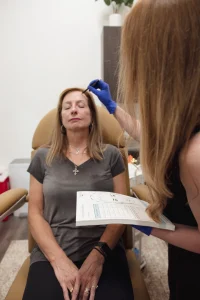
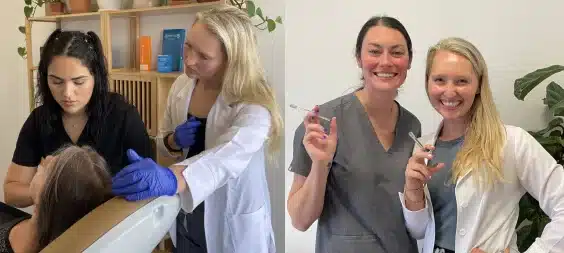
That gap is exactly what structured rn injector training is built to close, ideally with live models rather than mannequins.
Training: cost, format, and timeline
Most nurses can complete foundational didactic and hands-on training in a matter of days, then spend six to twelve months building speed and confidence.
Budget realistically. Course tuition is only one line item — factor in travel, your delegating-physician arrangement, malpractice coverage, and advanced modules later. We break the full picture down in our guide to Botox certification cost and how to choose a program.
For nurses who cannot leave the unit for two days, our best online Botox training covers the didactic foundation first, so your in-person day is spent injecting rather than sitting through slides. Once you are comfortable with the upper face, lip filler training in Texas is usually the highest-demand next skill to add.
Where to train
Hands-on training only works if you can physically get there. Our botox training texas programs run across the state — see all training locations or pick your metro directly:
Who should not make this switch
Credibility requires saying this plainly.
If you dislike selling, you will struggle — retention and rebooking are part of the role. If you need guaranteed income immediately, do not resign before your first commission cycle; bridge with PRN shifts. If you are drawn to aesthetics primarily to escape burnout rather than toward the work itself, the underlying problem tends to travel with you. And if perfectionism paralyzes you, understand that results are subjective and revisions are routine.
A realistic 90-day plan
Days 1–30: Confirm your license status, read your state’s delegation rules, and complete didactic training online while still employed.
Days 31–60: Attend hands-on training with live models. Inject as many patients as the course allows. Start photographing every case.
Days 61–90: Line up a delegating physician, apply to medspas and clinics, and offer to work part-time or PRN as an injector before you resign anything.
Nurses who follow that sequence rarely regret the change. Nurses who quit first and train later often do.
FAQs
Do I need to be an NP to inject Botox? No. RNs inject in most states, including Texas, under appropriate physician delegation and supervision. NP status changes your prescribing authority, not your ability to be trained.
How long until I am fast enough to be profitable? Most nurses feel competent on upper-face neuromodulator treatment within weeks and take six to twelve months to develop filler confidence and a returning patient base.
Is online-only training enough? For theory, yes. For injecting, no. Use online coursework to front-load anatomy and product knowledge, then complete supervised hands-on practice.
Reviewed by Kiara DeWitt, BSN, RN, CPN and Jen Adams, BSN, RN. Ready to start? Explore programs at InjectorTraining.org.